CT’s Path to Equity: Opportunities to be Healthy
Opportunities to be healthy are the conditions and circumstances that enable us to prevent illness and injury and maintain the best possible quality of life when disease or accidents occur.
These are the daily context in which people live, work, play, pray, and age and that affect their health. Systemic racism and its consequences have led to Black, Indigenous, and other people of color being more likely to experience barriers to health, including higher-wage jobs, health insurance, education, healthy housing, clean air and water, and more.
CT’s Path to Equity: Anti-Racist Structures
Anti-racist structures acknowledge that all people and institutions exhibit racism at some point or some way and are committed to dismantling racism through policies and practices that advance racial justice and promote equity.
CT’s Path to Equity: Access
Access is the ability to receive high-quality health care that meets each person’s needs. This means culturally and linguistically appropriate care, having the technology to monitor health or participate in telehealth, a workforce large and diverse enough to address each person’s needs, and community-based supports that help people get and stay as healthy as possible.
Connecticut’s Path to Equity
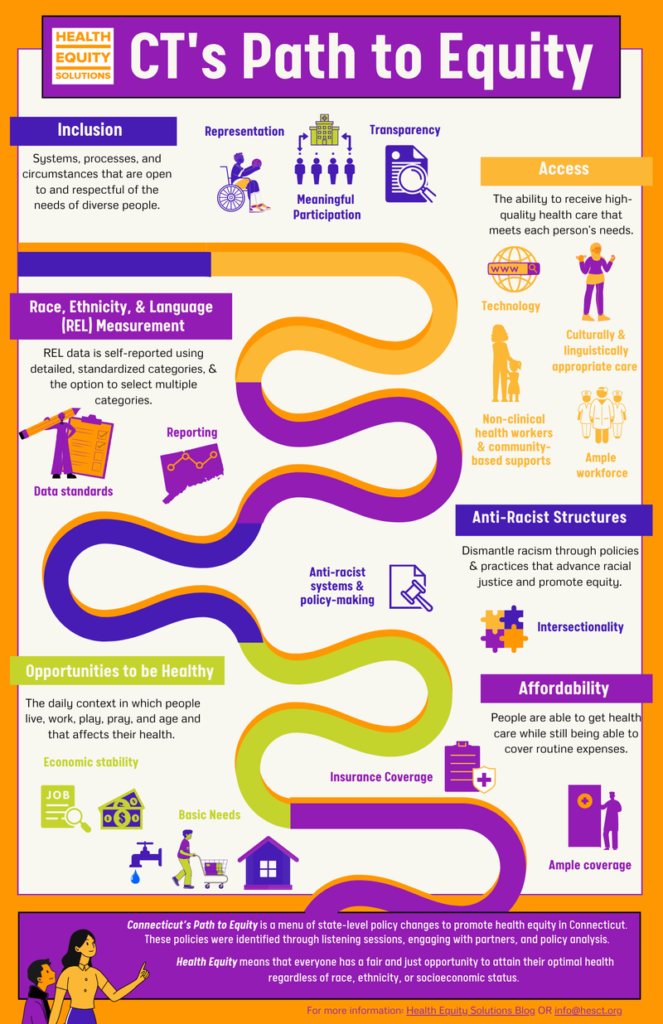
The path to equity is woven through every aspect of our policies, structures, and processes. At the same time, the steps Connecticut can take to dismantle structural racism and achieve health equity are concrete, feasible, and within our reach.
CT’s Path to Equity: Race, Ethnicity, and Language Measurement
Race, ethnicity, and language (REL) measurement means collecting, analyzing, and using data to identify and address health disparities. Quality REL data is self-reported using detailed, standardized categories and selecting multiple categories.
Strengthening and Sustaining Primary Care
Health Equity Solutions recently submitted a public comment on the Office of Health Strategy’s Roadmap for Strengthening and Sustaining Primary Care. This Roadmap is intended to inform the development of the state’s primary care infrastructure through health reforms that expand the team of providers caring for patients, align how they coordinate, and improve the system’s capacity to address social drivers of health by expanding payment options beyond a fee-for-service model.
Advancing Federal Race, Ethnicity, Primary Language, and Disability (RELD) Data
Health Equity Solutions recently sent a letter to Dr. Marcella Nunez-Smith and members of the COVID-19 Health Equity Task Force outlining recommendations for federal guidance and regulations to tackle existing barriers to race, ethnicity, primary language, and (REL) data collection.
Advancing Anti-Racism Among State Agencies
Health Equity Solutions recently sent a letter to the Commissioner of the Department of Social (DSS) Services outlining opportunities for DSS to leverage the ongoing policies and practices undertaken by Connecticut’s Department of Children and Families to address systemic racism.
American Rescue Plan Act Funding and Health Equity
As the state continues to work together to agree on proposals for allocating funding from the American Rescue Plan Act, we ask leadership to center health equity as the goal of this funding package.
The proposal for American Rescue Plan Act funding, which was passed out of the Appropriations Committee this week, reduces or removes several provisions of the initial proposal that would advance health equity.
Governor’s Proposed Federal Spending Plan
As we begin to gradually emerge from this pandemic, Health Equity Solutions aims to ensure that we learn from this past year and address the inequities it has so starkly highlighted. On Monday, Governor Lamont released a proposal for allocating federal funding from the American Rescue Plan Act with provisions that show promise for moving Connecticut towards health equity in the coming years